
Control, Uncertainty, and Anxiety
A contemporary interpretation of the Tree of Knowledge of Good and Evil

In my fascinating conversation with Dr. David Rosmarin on the Orthodox Conundrum Podcast, he discussed the intertwining of anxiety and uncertainty, along with the desire for control. In his words:
Control and anxiety and uncertainty are so tied together. When we realize the lack of control and the lack of certainty we have in this world, it makes us feel anxious. It's a natural response to feel a little bit uncomfortable until we lean into it and actually let go, and accept that we were never supposed to have control in the first place.
Listening to Dr. Rosmarin’s surprising explanation of anxiety, and to his assertion that “we were never supposed to have control in the first place,” led me to consider a new understanding of the Tree of Knowledge of Good and Evil in the Garden of Eden.1
The Tree’s nature has always been a mystery. If it conferred the ability to distinguish between good and evil, then presumably Adam and Eve lacked such discernment beforehand - in which case, they should not have been punished for violating God’s command to refrain from eating the Tree’s fruit, as they had no ability to know that doing so was evil. For this reason, Bible commentators have proffered countless attempts to explain the Tree’s power.
In light of Dr. Rosmarin’s insight, I thought that a complementary explanation of the Tree may be implicit in his words.
Perhaps the Tree’s power to confer the knowledge of good and evil refers not to man’s internal moral stance - his ability to know the difference between right and wrong - but instead to good and evil that exists in the world outside. Those who eat the Tree’s fruit, Adam and Eve hoped, would - in the words of the serpent - “be like God, knowing good and evil”; that is, they would no longer be puzzled by the question that plagues all human beings: the problem of theodicy. Even Moses was troubled by the problem of why bad things happen to good people; when he asked God for an explanation, Moses was told that the “answer” was not available to human beings.2 By eating the fruit of the Tree, Adam and Eve expected to understand the good and evil that exists in worldly circumstances outside of our control. In this way, they would be like God - certain and in complete control of events.
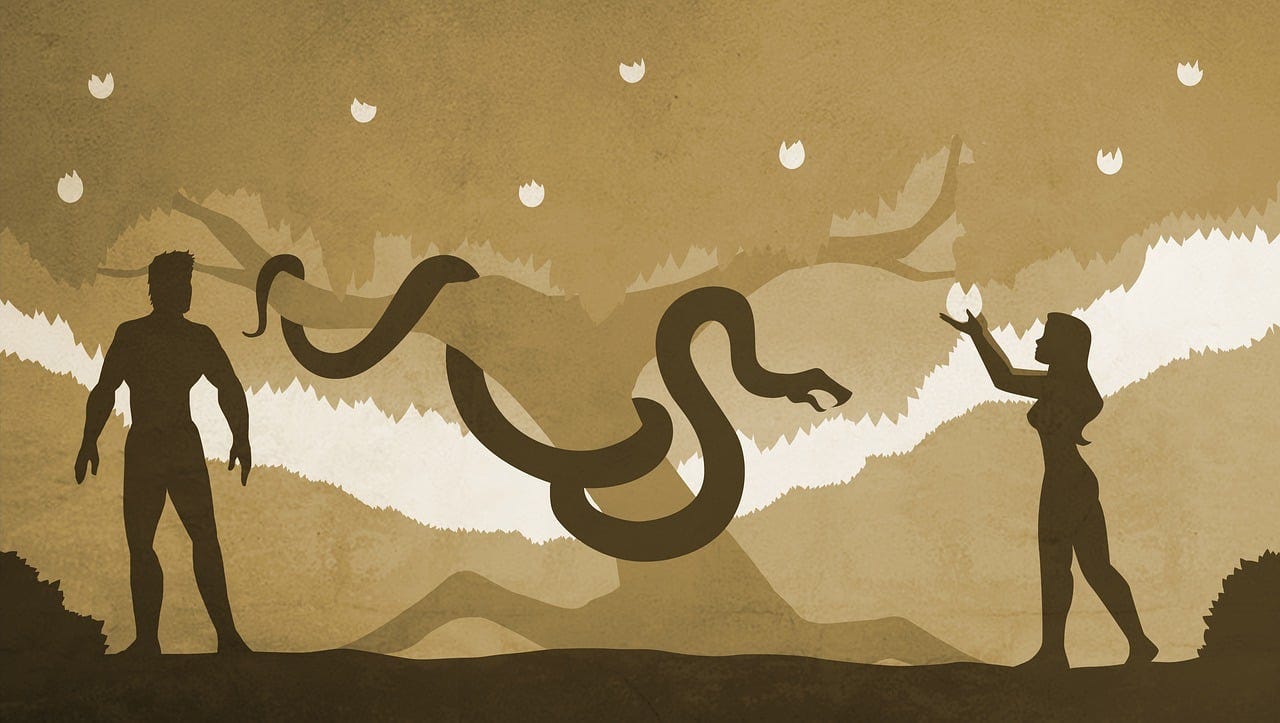
Of course, the Tree did no such thing - the divine mysteries remain impenetrable - but instead only strengthened the drive to acquire such knowledge. The Tree, that is, undermines our original recognition that “we were never supposed to have control in the first place,” and established a drive within us to probe the mysteries that are, inherently, unavailable to us.
One of the keys to personal redemption is to let go of this desire for complete control - the desire to control and comprehend all consequences - and to recognize that which we can and must control, and that which remains exclusively in God’s hands.
How, then shall we explain the Torah’s clear guidance that good actions lead to good consequences, just as bad actions do the opposite? Do we not daily recite the words in the Shema, “If you heed My commandments… I will give rain in your land at the right time… and you will gather your grain, wine, and oil… Be careful lest your heart be seduced, and you turn aside and worship other gods and bow down to them; God will be angry with you, closing up the heavens so that there is no rain, while the ground will not give its produce…”?3
To this, there are two clear answers. First, the Torah is speaking about good things affecting the population at large, rather than the much more variegated fates of individuals. Indeed, the Rambam writes at length about how these consequences for good and bad behavior are not rewards and punishments, which are given in the World to Come, but instead a type of divine encouragement to continue collectively on the path the people have chosen. When the nation behaves properly, that is, God helps them further by removing obstacles to continuing along this path; and when the people misbehave, God increases those national difficulties that make observance of the commandments more challenging.4 This, however, has nothing to do with the specific circumstances of the individual righteous or wicked person.
Second, even such national divine providence is only obvious in a time of redemption, when God’s presence is manifest. In a world that remains unredeemed, where God’s hiddenness may be His most obvious attribute, the meaning of God’s actions remains terrifyingly unclear. And sadly, we still live an unredeemed existence.
I do not mean to imply that divine providence is completely hidden at any time, but instead that clear divine intervention with unambiguous meaning is rare in our unredeemed world. Yes, we are at times obligated to try to understand why national tragedies take place5… but that is a far cry from making absolute statements that imply that we know the reasons for God’s actions. We are not in control, and we cannot know the full explanation no matter how hard we try.
Many religious leaders and teachers have an unfortunate tendency to explain the authentic meaning behind important personal or historical events that occur today, as if they are privy to heaven’s innermost secrets. As Rabbi Norman Lamm wrote in a parallel context, “These are some of the serious questions that beg to be discussed - seriously, soberly, softly, and without sloganeering. And if the answers offered are concise, clear, crisp, and uncomplicated - you may be quite sure they are crude and misguided, just plain wrong. Do not trust them! Life is complex. It is filled with paradox, riddled with ambiguity, suffused with subtlety and nuance, and simplistic answers are dangerously misleading.”6
When a Yosef Mizrachi “explains” why the Holocaust happened, or why children are born with birth defects… when a Meir Kahane opines that God “must” do our will if we follow the Torah… when too many rabbis offer simple explanations for the events of October 7th and its aftermath… we are falling into this hubristic trap. Unfortunately, too many people swap deep and humble theological reflection for similar simplistic interpretations of history, thinking that this represents authentic faith in God and Torah.
It does not. It is the enticement of the serpent, seducing us with the desire to be like God. And the result is inevitably either a regrettable shallowness, or a weakening of authentic faith.
We need to accept, as Dr. Rosmarin teaches us, that we were never supposed to have control and certainty in the first place. By letting that go, by acknowledging our ultimate ignorance, we deepen faith in God, and turn anxiety into a tool that can help us rather than an enemy that controls us.
We owe ourselves no less.
A new understanding, that is, for me. It is highly likely that I’m merely echoing the words of other Bible commentators who developed this insight years ago.
Berachot 7a. This represents the position of Rabbi Meir. Rabbi Yochanan, quoting Rabbi Yosi, argues that God did offer an explanation of sorts to Moses.
It is worth noting that the Talmud phrases the question of theodicy in a telling manner. Whereas the question is typically framed as, “Why do good things happen to bad people, and bad things happen to good people?”, Moses is quoted as asking, '“Why is there a righteous person who experiences good, and a righteous person who experiences evil, and a wicked person who experiences good, and a wicked person who experiences evil?” In other words, if the problem were simply that bad things happen to good people, one could easily argue that reward is given to the righteous exclusively in the World to Come, whereas the wicked receive whatever reward they have earned in this world. Moses, however, questions the seeming randomness of divine justice, in that some righteous people live wonderful lives, and others live though terrible tragedy. The problem is not injustice per se, but apparent randomness.
Devarim 11:13-17.
Mishneh Torah, Hilchot Teshuva 9:1.
Ibid., Hilchot Taaniot 1:1-3
Seventy Faces, volume 2, p.234.
Thank you for this view and especially for your quote of Rabbi N Lamm.
I have puzzled over this problem and do not find there to be a simple logical way for solving it. So I am forced to conclude that the way G-d works is not as straight-foreard as how we normally reason. Although all the things He does for us have a good long-term effect, the more locally based ones are all that we can see about them. These short-term things most likely can not be the same as the broader and overall results which He envisages and does, or will do or create in the longer term. What fools are we, who cannot see, woods for the tree!