
The War Against Torah
The claims of a fight against the Torah are, tragically, real

After a prolonged struggle, the Knesset today approved the law ending the persecution of Torah students and preventing their arrest. - UTJ MK Moshe Gafni
Yesterday, the Knesset voted 58-54 to stop the arrests of yeshiva students who have refused to report to the army after receiving draft orders.
This followed on the heels of the passage of another piece of legislation, the quasi-constitutional Basic Law: Torah Study, which states that “Torah study is a fundamental value in the heritage of the Jewish people and in the State of Israel.”
Last night, the Knesset passed additional legislation that restores the Chief Rabbinate’s monopoly on kashrut supervision. This law not only reverses the kashrut reforms passed in 2021 under then-Minister of Religious Services Matan Kahana - reforms which allowed competition in the market of kashrut supervision - but also gives additional power to the Chief Rabbinate to determine standards that all municipalities must follow. Thus, more than rolling back reforms, the new law consolidates control of kashrut supervision more than at any time in Israel’s history.
All three pieces of legislation, hurriedly passed before the Knesset formally dissolves this Friday in anticipation of the upcoming elections on October 27th, are characterized by their supporters as attempts at strengthening the position of Torah Judaism in the State of Israel.
Tragically, these new laws, and the heavyhanded, threat-filled ways that they have been passed during the government’s twilight, are going to do the exact opposite. Rather than making Torah great and glorious, they treat the Torah as a small, cowed victim which is far too weak to stand on its own.
Make no mistake: this is not the exclusive doing of the Chareidi parties in the government. While UTJ and Shas spearheaded the recent legislation, the other religious political parties - Religious Zionism, Otzmah Yehudit, and Noam - fell in line and helped pass the three laws. Only one MK from any of these parties, Moshe Solomon of Religious Zionism, voted no on any of these bills - and even Solomon voted in favor of the Orwellian-sounding “Prohibition of Fraud in Kashrut Bill” last night.1
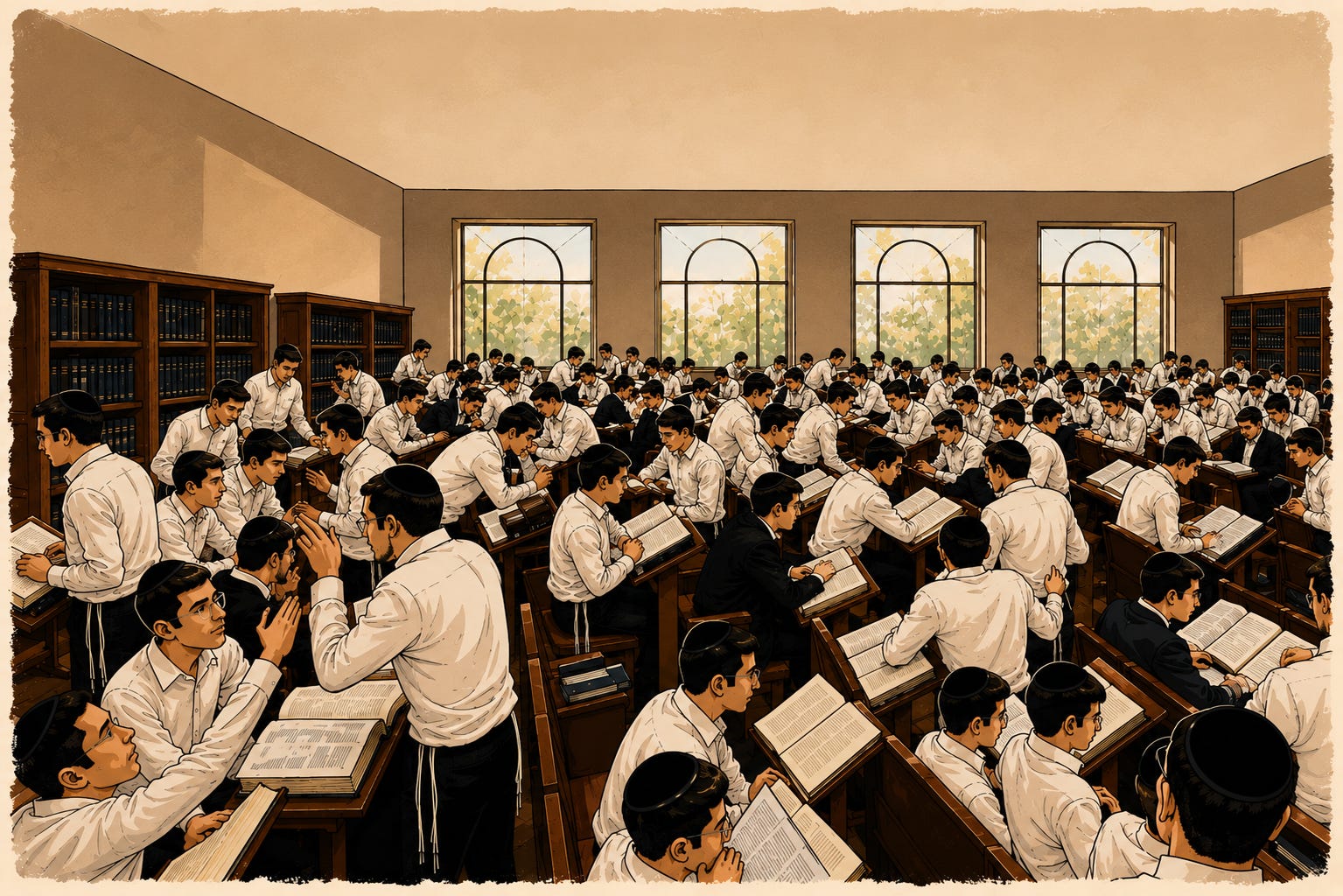
One can claim that arresting draft-dodging yeshiva students is counterproductive; that is a far cry from institutionalizing draft dodging as a legally acceptable practice, or stopping the arrests of only Chareidi draft-dodgers and not others. When thousands upon thousands of non-Chareidi soldiers are being called up for reserve duty again and again - I have repeatedly mentioned that in the year since my grandson was born, my son-in-law has been in the reserves three times, most recently for ten weeks - and when the IDF Chief of Staff Lieutenant General Eyal Zamir laments that the army now has “an unusual gap in manpower, which directly affects the ability to meet operational missions,” the idea that religious members of Knesset would spit in the face of those who serve by essentially formalizing freedom from prosecution for ultra-Orthodox deserters, is horrible. When people like Aryeh Deri celebrate the legislation by proclaiming, “Enough with the persecution. Enough with the hatred toward Torah students” - as if the desire for the military burden to be shared is a type of persecution or hatred - he merrily rubs salt in the wounds of those who have sacrificed their livelihoods, their health, their emotional wellbeing, and their very lives to protect him and those he represents.
Again: a person may believe that all yeshiva students should receive deferments from the army - and while I disagree, I do believe that this is a defensible position. Nevertheless, that is not the same as institutionalizing the freedom from all prosecution, and worse, claiming that the belief in universal conscription is a type of persecution or hatred of Torah students. That is simply motzi shem ra, slander, and the religious politicians who make such claims are violating the Torah in both letter and spirit.
The Basic Law asserting the primacy of Torah study subtly advocates something that no religious Jew doubts - the importance of limmud haTorah - in order to create a legal precedent for the future permanent exemption of yeshiva students from service in the IDF. Although the clause equating Torah study and military service was removed from the bill following a public outcry, the legislation nevertheless provides a legal standard that the Court can (or must) use to allow all military deferments for those who are in yeshiva. After all, the only value listed in any of the Basic Laws is not the protection of the Jewish people, or love of the Land of Israel, or the promotion of mitzvah observance, but the study of Torah. Should a future court attempt to force yeshiva students to serve in the IDF, that court would need to contend with the reality that the only value that appears in Israel’s quasi-constitution is learning Torah - and that fact, more than the unmentioned value of civic equality, would constrain the judges from overturning the legislation on constitutional grounds.
Yes, the Chareidi politicians profess this belief. But why would they do so in a way that makes the Torah the possession only of a certain segment of the population, while implicitly disenfranchising those who disagree with it? And why on earth would the non-Chareidi religious parties, which claim to want greater Chareidi participation in the IDF, vote alongside their anti-conscription coalition partners?
The new legislation that reestablishes the Chief Rabbinate’s monopoly on kashrut supervision, strengthening it more than ever before, continues the Rabbinate’s attempt to centralize rabbinic standards in a way that is utterly at odds with historic Torah practice over thousands of years. Rather than allow individual communities to choose their own rabbis and standards, the Rabbinate wants everything to follow its directives - whether the appointment of community rabbis, or the current decision to centralize kashrut standards for all geographical and religious communities. That kind of centralization has been absent from Judaism for two thousand years; and even when there was a Sanhedrin, the decision to unify practice was only taken in extreme and generally unwelcome circumstances.2
Yet the current religious Knesset members, in conjunction with the very political Chief Rabbinate, have dared to change Jewish tradition in ways that are utterly foreign to classic Jewish practice. In the name of supposedly strengthening standards (and, significantly, providing jobs for more politically-connected rabbis), they will inevitably disgust much of Israel’s nonreligious population, and turn them away from any future possibility of increased mitzvah practice.
Through legislation like this, the Rabbinate allows itself to seem like a heavy-handed authority, issuing binding rulings from on high while openly promoting cronyism and nepotism by providing jobs for those it favors. Should a nonreligious Jewish person claim that the Rabbinate is power hungry and corrupt, would we even dare to disagree?
Thus Israel’s religious establishment, represented by the 32 Knesset members from the five religious parties,3 decided to use the Torah as a wedge issue, further dividing the Israeli population and decisively using the Torah, in direct opposition to the directive of Rabbi Tzadok in Pirket Avot 4:7, “as a crown used to glorify yourself or a spade with which to dig.”
Torat Hashem temimah - God’s Torah is perfect. It does not need the dubious support of politicians who vainly try to raise her up without considering how such actions look to those outside the classically religious camp.
We need to encourage greater Torah observance and increased Torah study, for Torah, properly observed, can bring divinity into the world. Legislation to that effect dilutes Torah rather than strengthens it.
Nevertheless, the Chareidi politicians are right about one thing: there is, indeed, a war against the Torah.
They simply haven’t admitted that those fighting against the Torah are our religious politicians themselves.
Some MKs chose to absent themselves instead of voting for or against the legislation.
As I heard personally from Rabbi Herschel Schachter shlit’a.
United Torah Judaism, itself made up of Degel HaTorah and Agudat Yisrael; Shas; Religious Zionism; Otzmah Yehudit; and Noam.
Rabbi Lord Jonathan Sacks famously warned, "Don't mix religion and politics. You mix religion and politics, you get terrible politics and even worse religion."
I suppose that now there is a monopoly in ensuring kosher food is kosher according to the rabinut, the prices will take another leap upward. During the history of most European countries, the differences between religious and governmental needs eventually resulted (even after civil warfare), in a proper separation between them, with law-making being independent of the religious authorities. We have yet to reach this stage in our necessary and evolving process of becoming more civilized and democratic, hopefully without a civil war breaking out.